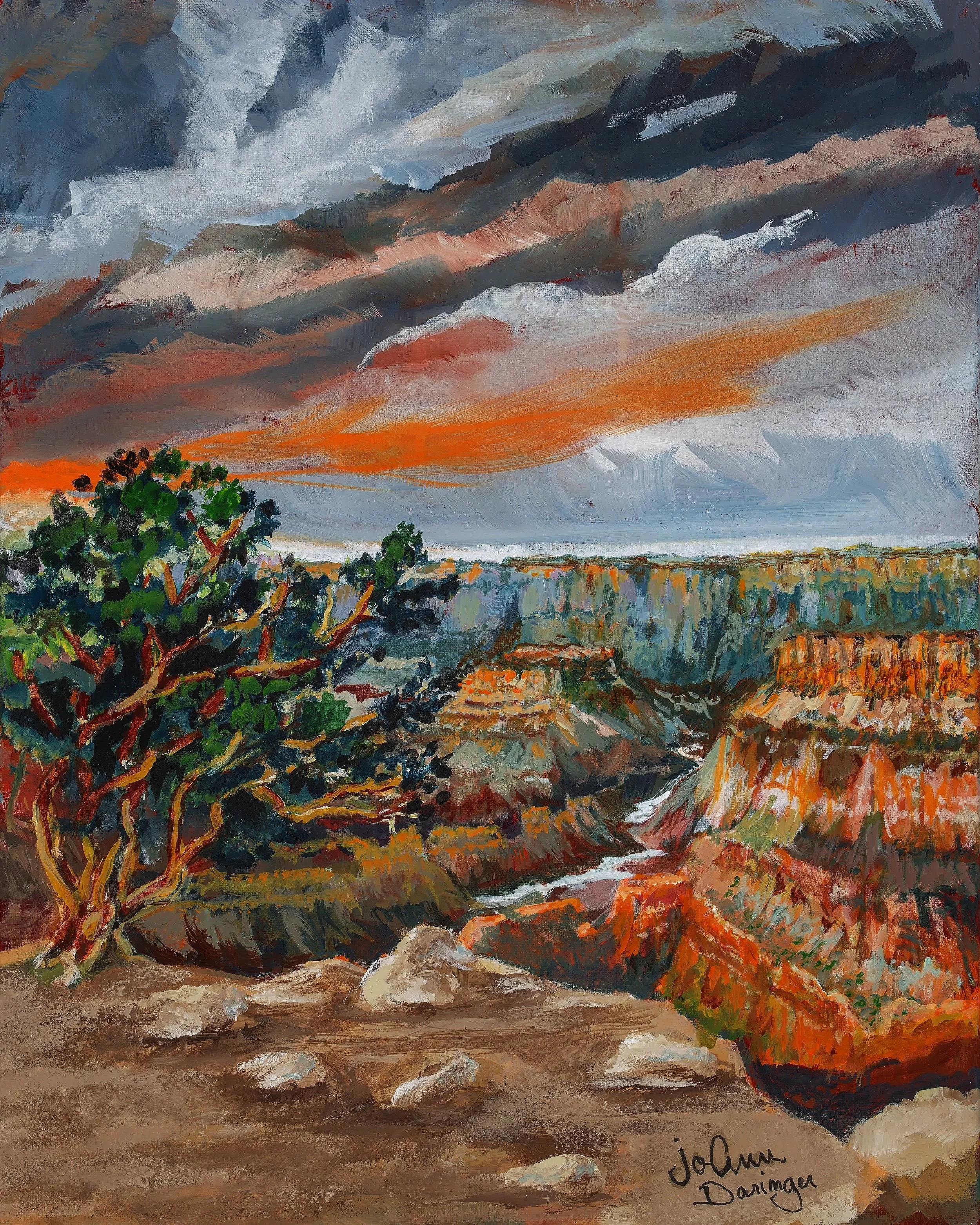
At sunrise and again at sunset, the low angle of the sun subtly changes how light interacts with the canyon’s layered rock and the surrounding atmosphere. The result is a wash of intense warm tones — fiery reds, deep oranges, soft pinks, and luminous golden yellows — that seem to “paint” the canyon walls with shifting bands of color. When clouds gather or the sky turns overcast, those hues become more muted and diffuse; when the air is exceptionally clear, the colors gain a striking clarity and saturation. Together with the vivid blue of daylight and the star-filled black of night, this shifting palette of light and color is a defining reason the Grand Canyon’s skies are so visually unforgettable.
Original Art: 16×20 acrylic on stretched canvas
At sunrise and again at sunset, the low angle of the sun subtly changes how light interacts with the canyon’s layered rock and the surrounding atmosphere. The result is a wash of intense warm tones — fiery reds, deep oranges, soft pinks, and luminous golden yellows — that seem to “paint” the canyon walls with shifting bands of color. When clouds gather or the sky turns overcast, those hues become more muted and diffuse; when the air is exceptionally clear, the colors gain a striking clarity and saturation. Together with the vivid blue of daylight and the star-filled black of night, this shifting palette of light and color is a defining reason the Grand Canyon’s skies are so visually unforgettable.
Original Art: 16×20 acrylic on stretched canvas